

Mediwell Air Ambulance Services in Tura: A Human-Centred Guide to Safe ICU Patient Transfers Across India
Most emergency calls begin with a simple but worrying sentence: “The doctor has advised us to move the patient.” What follows is rarely simple for the family. They must understand where the patient should go, how soon the journey can begin and whether the patient can safely tolerate the distance.
Mediwell Air Ambulance Services in Tura helps families turn that uncertainty into a medically planned journey. We coordinate the road ambulance, appropriate departure airport, flight, medical team, portable equipment and destination ambulance as parts of one transfer.
The purpose is not merely to move a patient quickly. It is to maintain suitable care from the present bedside in Tura until the receiving hospital accepts the patient.
The First Decision Is Medical, Not Travel
Families sometimes begin by searching for the fastest available flight. For a patient, however, the most important question is different: what support will be needed before, during and immediately after that flight?
A patient who is conscious and stable may travel with a nurse or paramedic on a scheduled airline. Someone who cannot sit upright may need an airline-approved stretcher. A patient who is ventilator-dependent, medically unstable or under intensive observation may require a dedicated charter aircraft with an advanced medical setup.
Mediwell reviews the available clinical information before recommending a transfer option. This helps prevent the family from choosing a journey that looks convenient on a timetable but does not match the patient’s condition.
Why Planning an Air Ambulance From Tura Needs Special Attention
For families in Tura and nearby areas of the Garo Hills, the road stage can be a significant part of the medical journey. The airport that appears closest on a map may not always have the right flight, aircraft access, stretcher approval or operational timing for a particular case.
Our coordinators therefore consider the complete route. They review how long the patient may spend in the ground ambulance, the suitability of the departure point, flight availability, weather conditions and the destination hospital’s readiness.
Sometimes a slightly different route can create a smoother and medically more practical transfer. This is why our service is planned as bed-to-bed care rather than an isolated aircraft booking.
Three Ways a Patient May Travel by Air
Dedicated ICU Charter
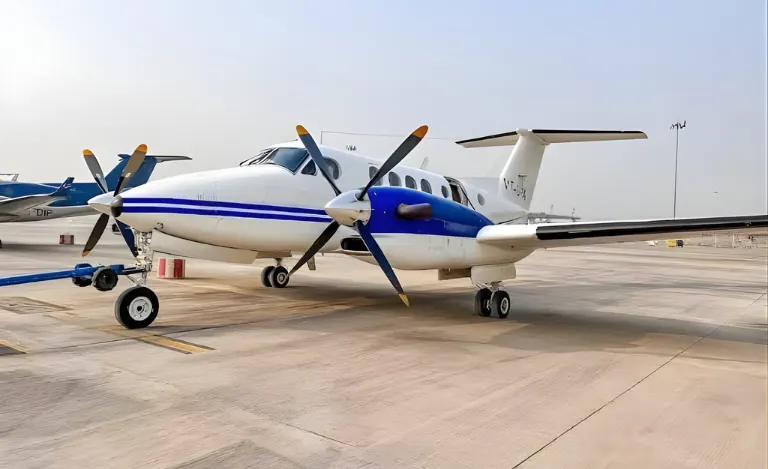
A charter air ambulance is reserved for the patient and prepared with the required portable medical equipment. This option is generally considered for critical, time-sensitive or high-dependency cases.
It allows the clinical team to care for the patient in a controlled cabin without the seating restrictions of a regular passenger aircraft.
Aircraft selection depends on the route, patient’s condition, required equipment, number of accompanying people and operational availability.
Commercial Airline Stretcher
A stretcher can sometimes be installed inside a commercial aircraft by blocking and modifying a group of passenger seats. It may be suitable for a stable patient who must remain in a lying position but does not require the full environment of a charter air ambulance.
The airline must review the patient’s medical forms and approve the arrangement in advance. Stretcher service is route- and flight-specific, so it cannot be booked like an ordinary passenger ticket.
Medical Escort in a Passenger Seat
A recovering or clinically stable patient may be fit to sit in a standard or business-class seat but still require oxygen, medicines, wheelchair assistance or professional observation.
In such cases, an appropriate medical escort can accompany the patient and respond if the condition changes during the journey.
The final travel method is selected after considering medical advice, airline requirements and operational feasibility.
One Journey, Six Carefully Connected Moments
1. The First Conversation
The coordinator listens to the family’s concerns and records the patient’s age, diagnosis, current condition, pickup location and destination.
Recent medical reports or a treating doctor’s summary help the team understand the urgency and required level of support.
2. Clinical Review
The medical team reviews the available information, including oxygen use, ventilator settings, blood pressure support, consciousness level, mobility and ongoing medicines.
If essential details are missing, the family or treating hospital may be asked for clarification.
3. Route and Resource Planning
A suitable air option, departure point, ground ambulances, medical team and portable equipment are identified.
The destination hospital’s timing is also considered so that the patient does not arrive without a prepared medical handover.
4. Preparation at the Bedside
Before leaving Tura, the transport team checks the patient, secures necessary lines or support devices and confirms that medicines, oxygen and medical equipment are ready for the planned journey.
5. Continuous Travel Care
Monitoring continues inside the ground ambulance, during patient boarding and throughout the flight. The medical team observes the patient’s vital signs and provides the planned clinical support.
6. Hospital Handover
After landing, the destination ambulance completes the final road journey. Important medical details are communicated to the receiving team so that responsibility for patient care changes hands properly.
Medical Support Selected for the Individual Patient
An air ambulance is sometimes described as a “flying ICU,” but not every patient requires the same ICU configuration.
Responsible planning means arranging the equipment and professionals that the patient is likely to need rather than using one standard setup for every case.
Depending on the medical assessment, the transfer arrangement may include:
- A transport ventilator and oxygen supply.
- A multiparameter monitor for vital signs.
- Infusion or syringe pumps for prescribed medicines.
- Portable suction equipment.
- A defibrillator and emergency response kit.
- A vacuum mattress or patient transfer stretcher.
- Medicines relevant to the patient’s condition.
The accompanying professional may be a doctor, critical-care nurse, paramedic or a suitable combination of medical staff. The team is selected according to the expected clinical needs during transportation.
Patients Who May Benefit From Air Medical Transfer
Mediwell Air Ambulance Services in Tura may be considered when a patient needs faster access to distant medical care or cannot safely manage prolonged ordinary travel.
Common situations include:
- Serious cardiac or neurological conditions.
- Trauma requiring treatment at a specialised centre.
- Ventilator-supported or oxygen-dependent patients.
- Transfers following major surgery.
- Oncology patients travelling for advanced treatment.
- Newborns or children requiring supervised transportation.
- Older patients with multiple medical conditions.
- Patients returning home after treatment in another city.
The service may also support transfers into Tura when a local resident is discharged from a distant hospital but still needs medical monitoring while returning home.
Questions We Ask—and Why They Matter
When a coordinator asks for medical details, it is not paperwork for its own sake. Every answer can influence the journey.
The patient’s diagnosis helps identify possible risks. Oxygen flow or ventilator information affects equipment planning. The ability to sit determines whether a medical escort, commercial stretcher or charter aircraft should be considered.
Pickup and receiving-hospital details influence the ground ambulance schedule. The preferred travel date shows whether regular coordination time is available or the case requires priority arrangements.
Families can assist the assessment by keeping the following information ready:
- Recent medical summary and investigation reports.
- Current medication list.
- Oxygen or ventilator details.
- Treating doctor’s contact information, where available.
- Identification for the patient and accompanying relative.
- Pickup address and destination hospital details.
Where Can Patients Travel From Tura?
Medical transfers can be planned from Tura towards treatment destinations such as Guwahati, Kolkata, Delhi, Chennai, Hyderabad, Bengaluru, Ranchi, Patna and other Indian cities.
Transfers from these and other locations back to Tura may also be coordinated.
Routes are not promised simply because a particular destination has been requested. The team first checks the patient’s condition, aircraft or airline availability, airport suitability, weather, ground travel requirements and operational permissions.
This keeps every recommendation practical and specific to the patient.
Understanding Air Ambulance Charges in Tura
There is no responsible way to quote every patient the same amount. Air ambulance cost depends on the complete route and medical arrangement, not only the flying distance.
Important cost factors include:
- Charter aircraft or commercial airline option.
- Location of the suitable departure airport.
- Destination and total flight duration.
- Required doctor, nurse or paramedic.
- Ventilator, oxygen and other equipment needs.
- Ground ambulances at the pickup and destination.
- Airport handling and operational requirements.
- Urgency and aircraft availability.
A stable patient may be eligible for a more economical medical escort or commercial stretcher service. A critically ill patient may need the space, clinical team and equipment of a dedicated charter aircraft.
Mediwell prepares a quotation after reviewing these requirements and explains the included services before confirmation.
What Makes the Experience Easier for Families?
A Single Point of Contact
One coordinating team connects the medical professionals, aircraft operator or airline, ground ambulances and hospitals.
This reduces the need for family members to repeat the same information to several different providers.
Honest Assessment of the Options
The team explains whether a charter, commercial stretcher or medical escort appears appropriate and what medical or airline approvals may be required.
Availability and fitness for travel are confirmed rather than assumed.
Respectful Patient Handling
Every movement—from the original hospital bed to the stretcher, ambulance and aircraft—is planned with attention to the patient’s dignity, comfort and medical condition.
Communication Without Confusing Language
Families need understandable answers during an emergency. Our coordinators explain the process in practical language and provide important updates while arrangements are progressing.
Care That Continues Beyond the Airport
When booked as a bed-to-bed transfer, the journey includes the destination ambulance and receiving-hospital handover.
The patient is not left for the family to manage immediately after the flight lands.
Our Purpose at Mediwell
Our mission is to make long-distance patient transportation safer to organise and less overwhelming for families. We aim to combine clinical responsibility, realistic route planning and compassionate communication in every transfer.
Our vision is an India where patients in cities such as Tura can reach suitable medical care without geography becoming an impossible barrier.
For Mediwell, dependable service means planning carefully, communicating honestly and remembering that there is a person—not just a booking—inside every ambulance.
Frequently Asked Questions
Is Mediwell Air Ambulance available 24/7 in Tura?
Families can contact the emergency helpline at any time. The earliest possible departure depends on the patient’s medical condition, readiness for transfer, aircraft or airline availability, weather, airport operations and required permissions.
Can a ventilated patient be transferred from Tura?
A ventilated patient may be transported after clinical assessment and confirmation of a suitable route, transport ventilator, oxygen quantity, monitoring equipment and medical team.
The current hospital should share accurate ventilator settings and medical information before the transfer.
Will you collect the patient directly from a hospital in Tura?
A suitable ground ambulance can be arranged from the patient’s hospital, nursing facility or residence as part of a bed-to-bed booking.
Pickup feasibility and the required ambulance category are confirmed during planning.
Is a commercial flight suitable for every patient?
No. Commercial travel is generally considered only when the patient is clinically stable and the airline approves the requested medical arrangement.
Critically ill or unstable patients may require a dedicated charter air ambulance.
Can a family member accompany the patient?
One relative may often travel, but this depends on available space, aircraft payload, onboard medical equipment and operator or airline approval.
The request should be discussed before finalising the booking.
How soon will we receive a quotation?
The team can prepare a more accurate quotation after receiving the route, recent medical reports and required support information.
Incomplete details may delay the assessment or result in an unsuitable initial estimate.
Do you arrange patient transfers back to Tura?
Yes. A patient can be transferred to Tura from another city when medically and operationally feasible.
Ground ambulance coordination for the final stage can also be included in the transfer plan.
Speak to a Mediwell Coordinator
If your doctor has advised a long-distance patient transfer, you do not need to solve every travel detail alone.
Call Mediwell and share the patient’s current condition, pickup location, destination, medical support requirements and preferred timing. Our team will review the case and explain the practical options for an air ambulance in Tura.
24/7 Helpline: +91-7484043872
Mediwell Air Ambulance Services in Tura—carefully connecting local care with distant treatment through one medically coordinated journey.